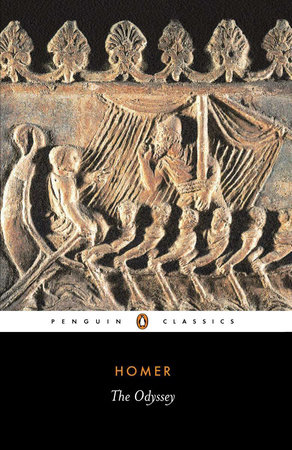
Rieu gives us the Odyssey as a story told in composed English prose. That sounds simple, but it was a consequential choice. His 1946 version launched Penguin Classics and addressed readers who did not know Greek and did not want a schoolroom exercise. The opening calls Odysseus “resourceful,” then moves through cities, suffering, and homecoming in one controlled paragraph.
The prose clears away one kind of difficulty and creates another. We can follow who speaks and what happens without adjusting to a long line or a recurring meter. We cannot hear where Homer placed the end of a verse, and repeated formulas settle into ordinary narrative. If you have tried two verse translations and found yourself reading around the sentences, Rieu may be the version that lets the poem become a book you finish.
Sun Kyoung Yoon’s study shows how deliberate that readability was. Rieu was reacting both to archaizing versions and to a culture of translation by scholars for scholars. He treated the Odyssey as an ancestor of the novel, then brought plot, character, psychology, and differentiated dialogue forward for readers used to modern fiction. The first Penguin Classic sold more than 100,000 copies within a few months and more than three million over its first fifty years. Ease was not a retreat from Rieu’s purpose. It was the purpose.
His ‘novelisation’ of The Odyssey and The Iliad was not limited to the process of transforming poetic rhythm and metre into straightforward prose.
Yoon also helps us name the cost. Rieu sometimes omitted formulaic adjectives, turned them into adverbs or clauses, replaced repeated expressions with their effect in context, and removed anonymous divine interventions. Those choices make the story flow and the characters feel more individual. They also hide some of the repetition and divine machinery that make Homer’s poem unlike a modern novel. Yoon’s examples come from E. V. Rieu’s original text, so we use them to understand his project, not to attribute every individual phrase to the later revision.
The edition matters here more than usual. Our passages come from D. C. H. Rieu’s 1991 revision, the text Penguin sells in its current paperback. The younger Rieu removed some of the original’s elaborations and dated conversational touches while trying to preserve its narrative ease. When someone says “the Rieu translation,” they may mean two distinct English texts.
Our three passages show the revised method clearly. “Resourceful” gives Odysseus a useful but fairly settled virtue. “Nobody” makes the Cyclops exchange transparent in dialogue. At the reunion, Penelope’s knees tremble and her heart melts, a fluent prose rendering that retains both bodily signs but turns one into a familiar emotional metaphor.
Choose the revised Rieu if prose is what will keep you reading. Wilson is nearly as clear and keeps a strict poetic form. Butler is free but older. Rieu sits between them: more novel-like than Wilson, much less dated than Butler, and less revealing than either Lattimore or Mendelsohn when we want to see how a Greek line is built.
Read it if you want the story in clear prose and would rather follow scenes and speeches than scan a poetic line.
Skip it if you care most about rhythm, formula, and the experience of reading an epic poem.
Three passage previews
We took each excerpt from the cited source edition and tell you where to find it in the book.
Tell me, Muse, the story of that resourceful man who was driven to wander far and wide after he had sacked the holy citadel of Troy. He saw the cities of many people and he learnt their ways. He suffered great anguish on the high seas in his struggles to preserve his life and bring his comrades home. But he failed to save those comrades, in spite of all his efforts. It was their own transgression that brought them to their doom, for in their folly they devoured the oxen of Hyperion the Sun-god and he saw to it that they would never return. Tell us this story, goddess daughter of Zeus, beginning at whatever point you will.Penguin ebook (2010) of D. C. H. Rieu's 1991 revision, reissued in 2003 · Book 1, opening invocation
“Cyclops,” I said, “you ask me my name. I’ll tell it to you; and in return give me the gift you promised me. My name is Nobody. That is what I am called by my mother and father and by all my friends.” The Cyclops answered me from his cruel heart. “Of all his company I will eat Nobody last, and the rest before him. That shall be your gift.” He had hardly spoken before he toppled over and fell face upwards on the floor, where he lay with his great neck twisted to one side, and all-compelling sleep overpowered him. In his drunken stupor he vomited, and a stream of wine mixed with morsels of men’s flesh poured from his throat.Penguin ebook (2010) of D. C. H. Rieu's 1991 revision, reissued in 2003 · Book 9, false-name exchange and aftermath
At his words her knees began to tremble and her heart melted as she realized that he had given her infallible proof. Bursting into tears she ran up to Odysseus, threw her arms round his neck and kissed his head. ‘Odysseus,’ she cried, ‘do not be angry with me, you who were always the most understanding of men. All our unhappiness is due to the gods, who couldn’t bear to see us share the joys of youth and reach the threshold of old age together.Penguin ebook (2010) of D. C. H. Rieu's 1991 revision, reissued in 2003 · Book 23, recognition and reunion after the bed test
Sources and further reading
These are the sources we used to test our own reading and understand each translator's method.
-
Sun Kyoung Yoon. Popularising Homer: E. V. Rieu's English Prose Translations. The Translator 20.2, 2014.
The most directly relevant scholarly account of Rieu's general-reader project, novelistic method, and the cultural reach of the first Penguin Classic. -
H. D. F. Kitto. The 'Penguin' Odyssey. Greece & Rome 16.47, 1947.
A substantial early classicist's review of Rieu's prose method and individual decisions. -
D. C. H. Rieu. Preface to the revised translation of The Odyssey. Penguin Classics, 1991.
Explains what the revision changes in E. V. Rieu's original 1946 text and what it deliberately keeps.