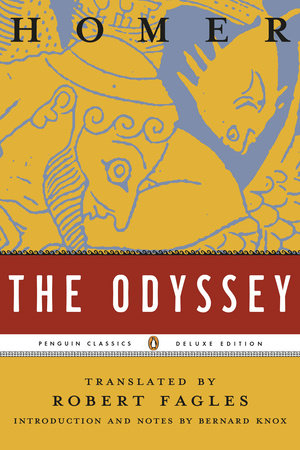
Fagles makes a strong case for giving the poem room. His free verse is longer and looser than Wilson’s or Lattimore’s line. Speeches have space to gather force, and transitions can swing into the next scene. In the opening, “twists and turns” puts the hero’s defining quality into motion. It sounds like a story that has already begun. Of the versions in our guide, this is the one most likely to make you want to hear the poem performed.
That looseness is deliberate. Fagles is not trying to make every English line answer to one Greek line. He is trying to carry the scene’s energy across a longer stretch of English. So we should judge him by the movement of a speech or episode, not by whether a phrase sits in exactly the place we expect from another translation.
The three passages also show us what Fagles adds. He keeps the familiar “Nobody” in the Cyclops episode. In the reunion, he builds a larger language of proof and surrender. These additions make the emotional stakes clear and heighten the drama, even when they go beyond the most economical version of the Greek. The English is elevated and forceful, and it is meant to carry across a room.
Choose Fagles when you want epic scale, especially if you plan to read aloud or listen. Choose another translation if you need each English line to guide you back to the Greek, or if a long line makes you impatient. Lattimore is more useful for tracking formula and structure. Wilson reaches the point faster. Fagles makes his extra space feel full rather than padded.
Read it if you want epic scale, forceful speeches, and a version that reads powerfully aloud.
Skip it if you want line-for-line correspondence or the shortest route through the poem.
Three passage previews
We took each excerpt from the cited source edition and tell you where to find it in the book.
Sing to me of the man, Muse, the man of twists and turns driven time and again off course, once he had plundered the hallowed heights of Troy. Many cities of men he saw and learned their minds, many pains he suffered, heartsick on the open sea, fighting to save his life and bring his comrades home. But he could not save them from disaster, hard as he strove — the recklessness of their own ways destroyed them all, the blind fools, they devoured the cattle of the Sun and the Sungod wiped from sight the day of their return. Launch out on his story, Muse, daughter of Zeus, start from where you will —sing for our time too.Penguin Books electronic edition (2002; translation first published 1996) · Book 1, opening invocation
‘So, you ask me the name I’m known by, Cyclops? I will tell you. But you must give me a guest-gift as you’ve promised. Nobody —that’s my name. Nobody — so my mother and father call me, all my friends.’ But he boomed back at me from his ruthless heart, ‘Nobody? I’ll eat Nobody last of all his friends — I’ll eat the others first! That’s my gift to you!’ With that he toppled over, sprawled full-length, flat on his back and lay there, his massive neck slumping to one side, and sleep that conquers all overwhelmed him now as wine came spurting, flooding up from his gullet with chunks of human flesh —he vomited, blind drunk.Penguin Books electronic edition (2002; translation first published 1996) · Book 9, false-name exchange and aftermath
Penelope felt her knees go slack, her heart surrender, recognizing the strong clear signs Odysseus offered. She dissolved in tears, rushed to Odysseus, flung her arms around his neck and kissed his head and cried out, “Odysseus —don’t flare up at me now, not you, always the most understanding man alive! The gods, it was the gods who sent us sorrow — they grudged us both a life in each other’s arms from the heady zest of youth to the stoop of old age.Penguin Books electronic edition (2002; translation first published 1996) · Book 23, recognition and reunion after the bed test